How Long Does A Water Heater Last?
Tank heaters usually last 10 to 15 years, but the real answer depends on water, maintenance and where the unit sits.
- Sourced guidance
- High Point area
- Updated October 2026
Most Tank Water Heaters Last 10 To 15 Years
According to the U.S. Department of Energy, typical storage tank water heater life is 10 to 15 years, and tankless units last 20 years or more. A heater that reaches 10 years has used most of its expected life, even if it still works. A heater past 12 years deserves a plan, not just hope.
Those numbers are averages. A well-maintained tank in a conditioned closet can outlast a neglected one in a hot garage by several years. This guide shows what moves the number, how to find your own unit's age and when to replace it on your schedule instead of during a leak.
Typical Life By Water Heater Type
Life spans differ by technology and by what you do with the unit.
| Type | Typical life | What shortens it | What extends it |
|---|---|---|---|
| Gas tank | 10 to 15 years | Sediment buildup, a spent anode rod, poor venting | Yearly flush, anode rod checks |
| Electric tank | 10 to 15 years | Failed elements, sediment, a spent anode rod | Yearly flush, element checks |
| Heat pump (hybrid) | 10 to 15 years | Clogged air filter, blocked condensate drain | Cleaning the filter and drain |
| Tankless | 20 years or more | Scale on the heat exchanger, clogged inlet screen | Annual flush, clean screen |
What Actually Wears A Tank Out
Every steel tank has a glass lining and a sacrificial anode rod, usually magnesium or aluminum. The rod corrodes first, on purpose, to protect the steel. Once the rod is gone, the tank wall starts to rust, and a rusted-through tank cannot be repaired. Checking the rod every few years is the cheapest way to add life.
Sediment is the other factor. Minerals and fine particles settle at the bottom and insulate the water from the burner or element, so the heater works harder and runs hotter. A yearly flush clears most of it, which is why manufacturers recommend one.
What Soft Water Changes In The High Point Area
The City of High Point's annual water quality reports, published from 2016 through 2019, listed hardness at roughly 30 to 60 mg/L, which is soft. Scale builds slowly in that water. A tank here is more likely to fail from age and a spent anode rod than from a limescale crust.
That does not make the heater maintenance-free. Fine sediment still collects, and a heater in an unheated garage or crawlspace faces temperature swings that stress fittings and valves. Many south-side ranches keep the heater in the garage, and mill houses often have it in a tight crawlspace.
Heater Showing Its Age?
Call for a free replacement estimate or a 24/7 repair if it is already failing.
How To Read Your Water Heater's Age
- 1
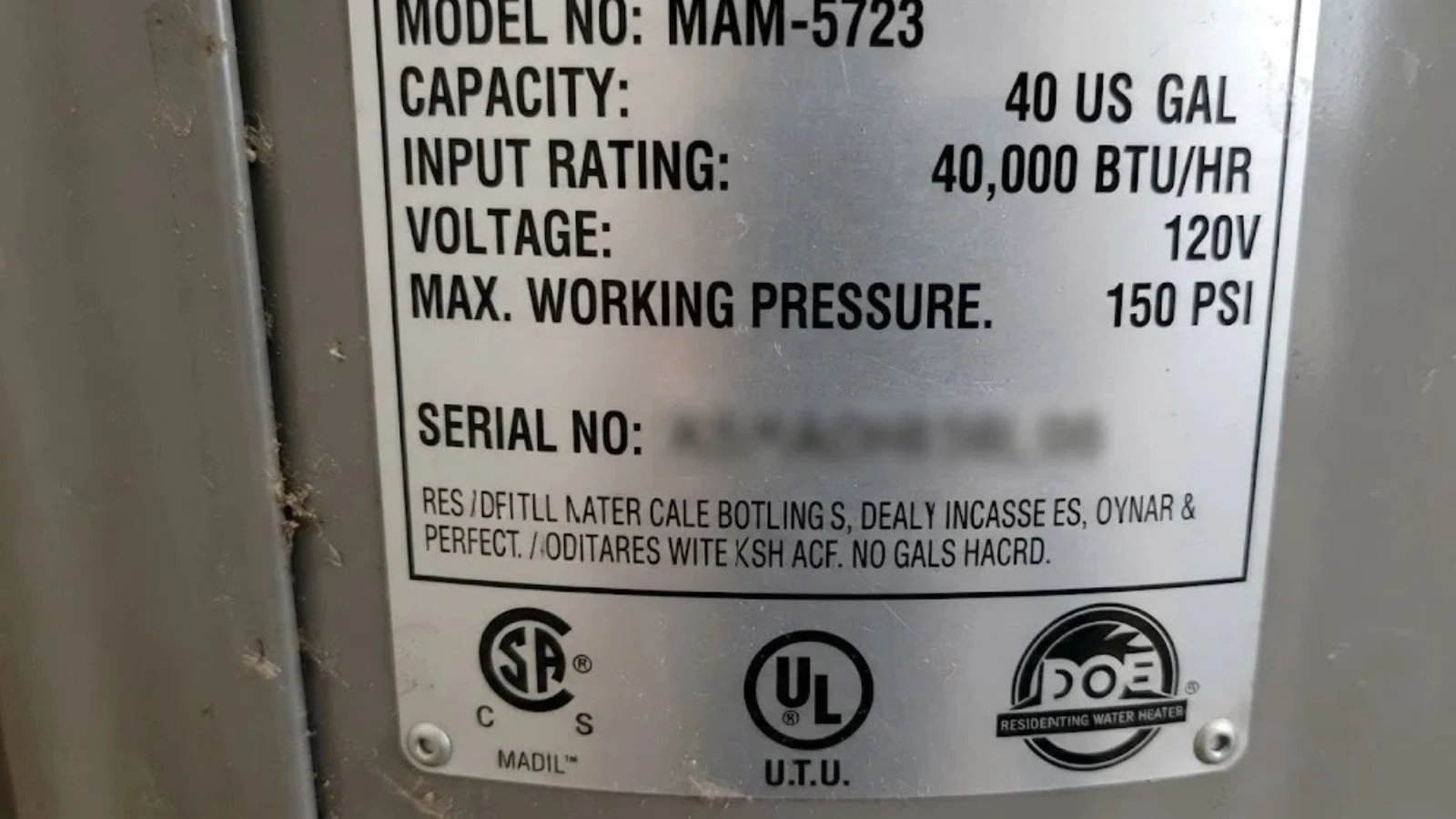
Find the label
Look for the rating plate on the side of the tank.
- 2
Read the serial number
Many brands encode the build month and year in the first digits.
- 3
Check the maker's chart
Each manufacturer publishes its own code, so look yours up.
- 4
Add it up
Subtract the build year from this year, and note any rust or leaks.
What To Do When Your Heater Starts Acting Old
These signs mean replacement is near. Act before the tank fails.
- 1
Look at the base of the tank for moisture, rust trails or a puddle.
- 2
Listen for rumbling or popping, which is sediment boiling at the bottom.
- 3
Watch for rusty hot water, which points to tank corrosion.
- 4
Note any drop in hot water volume, which can mean a failed element or heavy sediment.
- 5
If you see leaking water from the tank shell, shut off the cold supply and the power or gas, then call.
When To Fix It And When To Replace It
A heater under about 10 years old with a failed thermostat, element or igniter is usually worth repairing. Past 12 to 15 years, or with any leak from the tank shell, replacement is the better value. The page on water heater repair covers the common repairs, and water heater replacement service covers choosing a new unit.
Planning ahead lets you compare tank, tankless and heat pump options, schedule the work and avoid a flooded closet. Homeowners in Jamestown and the other nearby towns are covered by the same dispatch.
Warranty Versus Real Life
Tank water heater warranties often run from six to twelve years, and they usually cover the tank itself, not the labor to swap it. A longer warranty does not mean a longer life, and many warranties are void if the unit was installed without a required part such as an expansion tank or drain pan. Read the terms before you rely on them.
Keep the receipt, the model and serial number, and a photo of the rating plate. If the tank fails inside the warranty window, those records speed up a claim. Registering the unit with the manufacturer, where required, is worth the few minutes it takes.
Replacing On Your Schedule Instead Of During A Leak
A planned replacement lets you compare tank, tankless and heat pump units, pick a day and avoid paying for water damage on top of the heater. A failed tank can release dozens of gallons into a closet or garage within minutes, and wet drywall and flooring cost more than the heater.
Cheap protection helps while you wait. A drain pan with a drain line catches small leaks, a battery water alarm on the floor warns you early, and a shutoff valve you have tested lets you stop the supply in seconds. Make sure the cold-water shutoff above the heater turns before you need it.
Water Heater Lifespan Questions
On soft city water, a softener is not needed for the heater. In hard-water areas, softened water can reduce scale, though it does not remove the need for sediment flushing and anode rod checks.
Yes. Flush the tank yearly, check the anode rod every few years, keep the temperature around 120 degrees Fahrenheit and keep the area around the heater clear.
Water pooling at the base that returns after you dry it, with no leak from the pipes above, usually means the tank shell has failed. A plumber can confirm.
It is worth planning for. The unit is near the end of typical life, and a planned replacement costs less than an emergency one with water damage.
The Department of Energy says 20 years or more for a well-maintained unit. Annual flushing and a clean inlet screen are what get it there.
Heater near the end? Call for an estimate.
Call (336) 453-0472Water Heater Past 10 Years?
Call for a free replacement estimate in High Point, Jamestown, Archdale, Trinity, Thomasville, Randleman or Greensboro.
Call (336) 453-0472