Tank Or Tankless Water Heater: A Decision Guide For Triad Homes
Neither type wins every time. The right pick depends on your gas line, your household and how you use hot water.
- Sourced guidance
- High Point area
- Updated October 2026
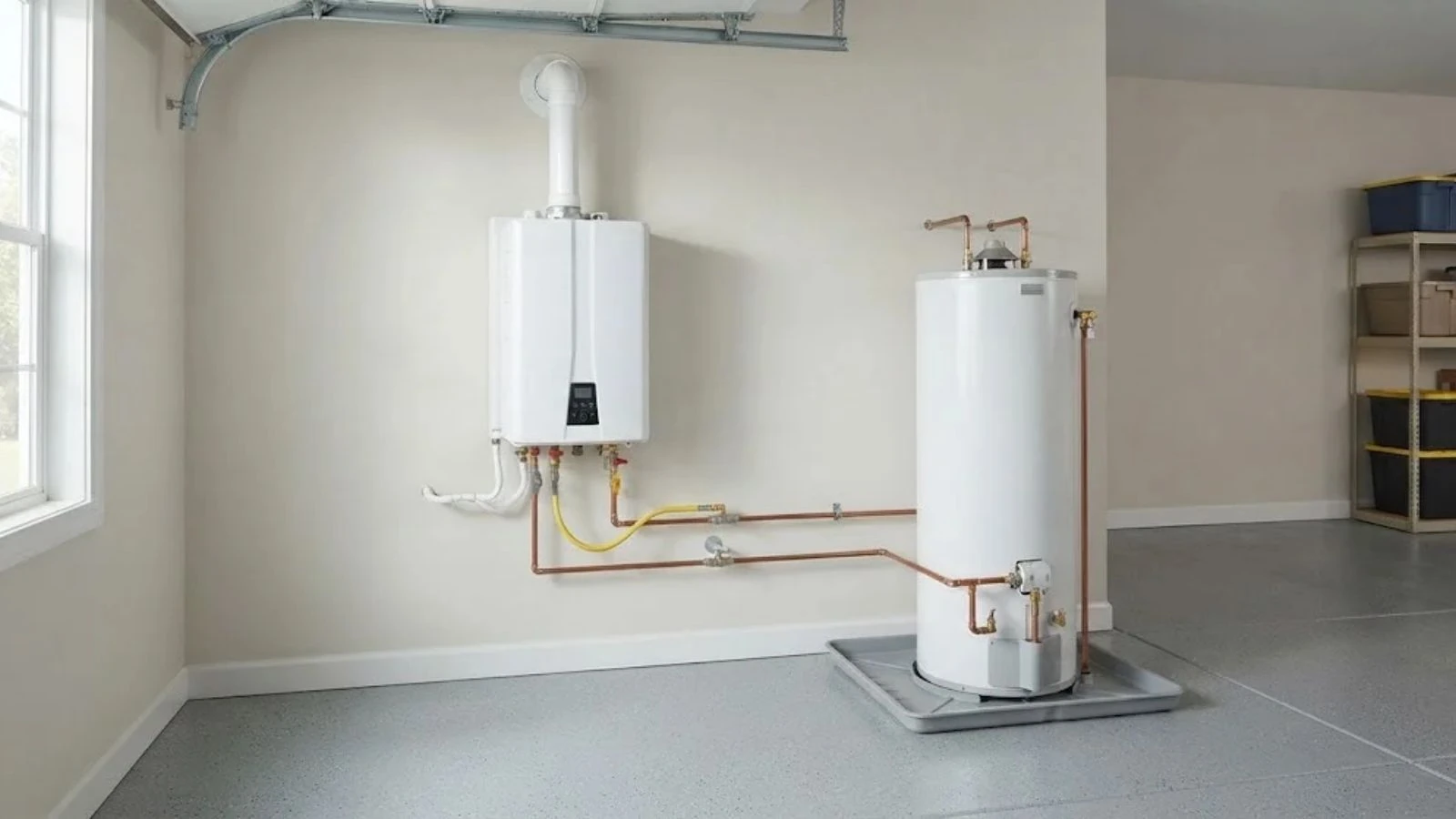
Tankless Costs More Up Front And Lasts Longer
A tankless water heater heats water only when you open a tap, so it never runs out and wastes no energy keeping a tank hot. A tank heater costs less up front and is simpler to install, but it can run out of hot water and loses some heat while it sits. Which wins depends on your house.
The U.S. Department of Energy says demand water heaters can be 24 to 34 percent more energy efficient than storage tanks in homes that use about 41 gallons of hot water a day or less. In homes that use a lot, the gain is 8 to 14 percent. The savings are real but smaller in busy households.
How The Two Types Compare
Tank water heater
- Lower purchase and install cost
- Works with existing gas line and vent in most homes
- Limited hot water until it recovers
- Typical life of 10 to 15 years
Tankless water heater
- Higher purchase and install cost
- Often needs a larger gas line and new venting
- Continuous hot water, within the unit's flow limit
- Typical life of 20 years or more
Which Type Fits Which Household
Use this table as a starting point, not a verdict.
| Situation | Better fit | Why |
|---|---|---|
| Small household, simple plumbing, tight budget | Tank | Lowest cost, easiest swap |
| Large household with back-to-back showers | Tankless or large tank | Never runs out, if the unit is sized right |
| Older house with a small gas line | Tank, or tankless with line upgrade | Gas line upgrades add cost |
| Garage or basement with air space, electric home | Heat pump (hybrid) | Uses far less electricity than a standard electric tank |
| Planning to stay 15 or more years | Tankless | Longer life can offset the higher price |
| Rental property | Tank | Simple and inexpensive to replace |
Want Help Choosing?
Estimates for water heater replacement are free. Describe your house and your hot water use.
The Part Most Buyers Miss: Gas Line And Venting
A tankless gas unit can draw close to 200,000 BTU per hour, several times what a tank uses. Many 1940s to 1980s houses in the High Point area have gas piping sized for a stove and a furnace, so the line may need upsizing. Venting is also different, often through a wall with special pipe.
Those extras explain most of the price gap between the two types. Ask any plumber to measure the existing gas line and meter before quoting. The page on gas line service explains how gas lines are sized.
Does High Point's Soft Water Change The Answer?
Tankless advice is usually written for hard-water cities where scale threatens the heat exchanger. The City of High Point's published hardness readings run roughly 30 to 60 mg/L, which is soft. Scale builds slowly here, so the maintenance penalty for tankless is milder than the national warnings suggest.
Annual flushing is still recommended by manufacturers, and it often matters for warranty. See tankless service for what a flush involves.
Federal Rules And Heat Pumps
Federal efficiency rules in place since April 2015 mean most electric tanks above 55 gallons are heat pump models. That makes the heat pump option relevant for all-electric homes replacing a large electric tank. A heat pump unit needs roughly 700 to 1,000 cubic feet of air space and a condensate drain, so it suits garages and basements better than closets.
Whatever you pick, work follows the NC Plumbing Code, which is based on the International Plumbing Code (IPC). Permit rules depend on scope, and many like-for-like replacements are exempt under state law. The installer should confirm with the local inspections office.
A Simple Way To Decide
- 1
Count hot water use
Note how many people shower and run appliances at the same time.
- 2
Check the gas line
Have the plumber measure the pipe and the meter capacity.
- 3
Price both
Get a quote for each type with all required extras.
- 4
Weigh the years
If you will stay 15 years or more, the longer life counts.
Where To Go From Here
To compare options in detail, read about water heater installation and replacement. Homeowners in Greensboro, where many houses date to the 1970s and 1980s and still run their original tank heaters, use the same estimate process.
What The Price Difference Is Made Of
The gap between tank and tankless comes from the parts around the unit, not only the unit itself. A tankless gas heater may need a larger gas line, new sealed venting, isolation valves for flushing, a condensate drain on condensing models and an electrical outlet for its controls. Each is a line item on the quote.
A good estimate lists all of them. If two quotes differ widely, compare what each includes. Skipping isolation valves, for example, makes the unit cheaper now and harder to flush later.
Hot Water Habits Decide The Size
Tankless units are sized by flow rate and temperature rise. A shower and a bathroom faucet together may draw four or five gallons a minute, and a dishwasher or washer adds more. Incoming water is colder in winter, so the same unit delivers less hot flow in January than in July. Ask the plumber to size for your coldest month.
Tank heaters are sized by first-hour rating, the hot water the tank can supply in a busy hour. Households with a large soaking tub or several morning showers should size up. Either way, describe your peak hour to the plumber instead of guessing.
Tank Versus Tankless Questions
It can be, especially for large households and homes where you plan to stay a long time. The higher up-front cost and any gas line upgrade are the main trade-offs.
They deliver hot water continuously, up to the unit's flow limit. Running several showers and appliances at once can exceed it, so sizing matters.
Sometimes. The gas line, vent and mounting wall have to suit it, and the plumber should check them before quoting.
They can be efficient in the right location. They need air space and a drain, and they cool the room around them.
For tanks, size by the first-hour rating and your peak use. For tankless, size by flow rate and temperature rise. A plumber can calculate both.
Ready to choose? Call for a free estimate.
Call (336) 453-0472Tank Or Tankless?
Call for a free water heater estimate in High Point, Jamestown, Archdale, Trinity, Thomasville, Randleman or Greensboro.
Call (336) 453-0472