Galvanized, Copper Or Polybutylene? How To Identify Your Home's Pipes
The era of your house tells you what is probably in the walls. A few simple tests confirm it.
- Sourced guidance
- High Point area
- Updated October 2026
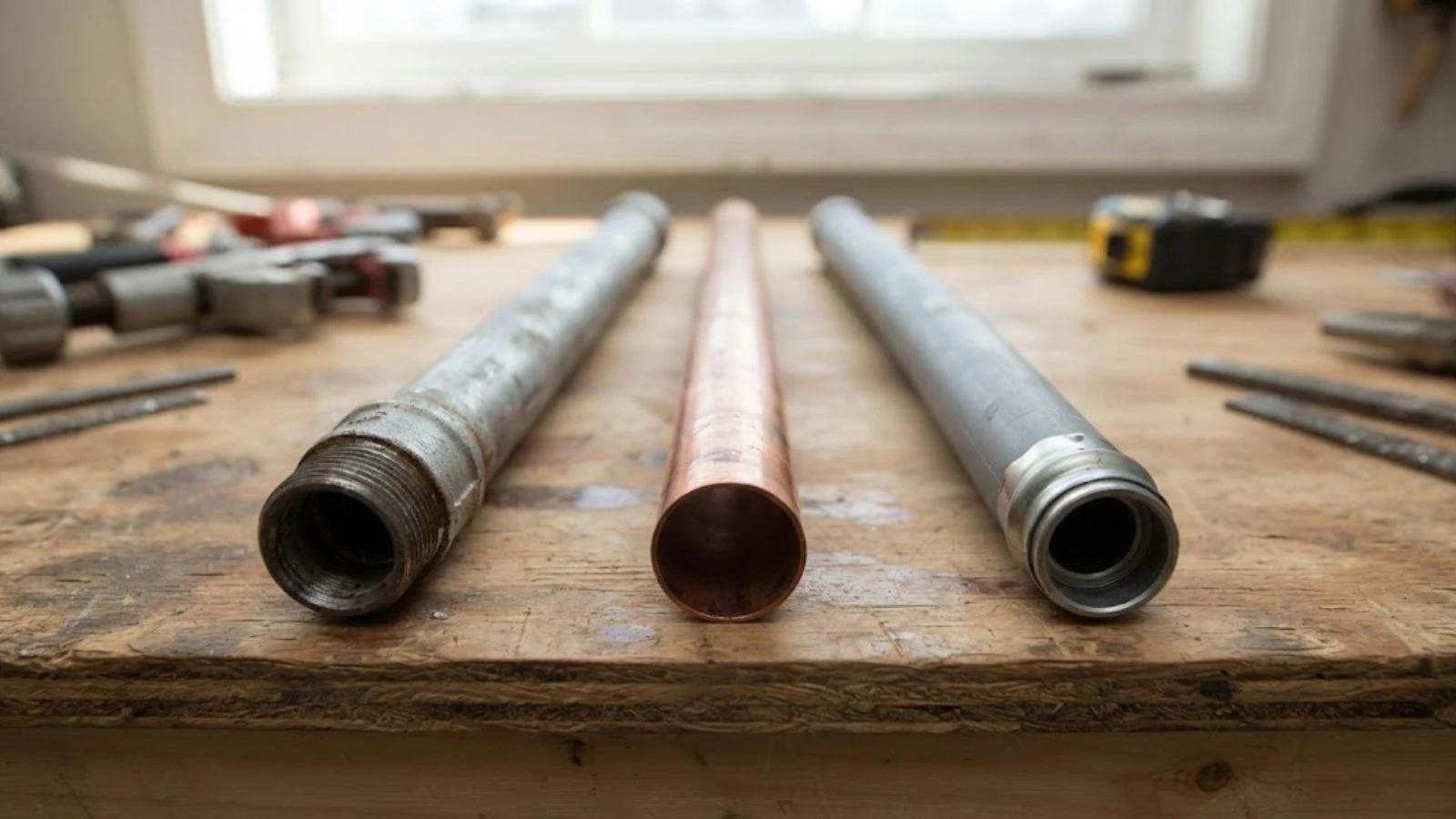
Pipe Material Predicts Problems
Each supply pipe material fails in its own way. Galvanized steel rusts from the inside, polybutylene has a documented failure history at its fittings, and copper can pinhole in some conditions. Knowing what you have helps you decide when to repair and when to replace.
You can usually identify the material in minutes by looking at exposed pipe near the water heater, under a sink or in a crawlspace. This guide shows how, and what to do with the answer.
How To Recognize Each Material
Always look at exposed pipe, never cut or drill into a wall to find out. The International Plumbing Code (IPC) lists the approved materials for water supply piping, and PEX should be marked to the ASTM F876 standard.
| Material | What it looks like | Simple test | Typical era |
|---|---|---|---|
| Galvanized steel | Dull gray, threaded joints, often rusty | A magnet sticks | Before about the 1960s |
| Copper | Reddish brown or green, soldered joints | A magnet does not stick, and a scratch shows copper color | 1950s to present |
| Polybutylene | Gray, blue or black flexible plastic, with crimp rings | Stamped with PB | About 1978 to 1995 |
| CPVC | Cream or yellow rigid plastic | Stamped CPVC | 1980s onward |
| PEX | Flexible plastic, often red, blue or white | Stamped PEX | 1990s onward |
Not Sure What You Have?
Call and describe the pipe. A plumber can often identify it from a photo.
Galvanized Steel In Older High Point Houses
Houses in the Uptown Suburbs district, built from 1903 to 1963, and the mill houses near Highland Cotton Mills are the likeliest places to find original galvanized supply lines. The zinc coating wears away, rust builds up inside, and flow drops until a shower runs weak. Rust-colored water on first use is another sign.
Galvanized pipe that has not leaked yet can still be near the end of its life, and rust inside restricts flow. Repeated pinholes and low pressure are good reasons to price a whole-home pipe replacement.
Polybutylene: A Known Problem Material
Polybutylene was widely used from about 1978 to 1995. It is gray, blue or black, and it tends to fail at the fittings, often without warning. Some insurers ask about it, and some charge more or decline coverage.
If your house was built in that window and you find polybutylene, plan to replace it. A failure can flood a house quickly, as described under burst pipe service.
Copper: Durable, But Not Immune
Copper has a long record, but it can pinhole in some water chemistry and fail at old solder joints. High Point's published hardness runs roughly 30 to 60 mg/L, which is soft, and very low-mineral water can be more aggressive toward copper depending on pH. For repeated pinholes, ask your plumber to read the pH and alkalinity in the city's water quality report. Green crust at joints, blue-green stains and small spray leaks are the usual signs.
What To Do After You Identify Your Pipes
The answer shapes your next move.
- 1
Photograph the pipes and the stamps on them for your records.
- 2
If you have galvanized or polybutylene pipe, ask a plumber to assess condition and flow.
- 3
Check your insurance policy for exclusions tied to pipe material.
- 4
Run a meter test for hidden leaks, as described on the leak detection page.
- 5
Get a written estimate if replacement is likely.
Finding Leaks Before You Decide
If you suspect hidden leaks in old pipe, electronic leak detection locates them before you commit to a replacement. Pipe identification is available as part of any estimate in Thomasville and the other nearby towns.
Indirect Ways To Tell What Is In The Walls
If you cannot see supply pipe, look at the connectors at the water heater, the pipe where the main enters the house and the lines under sinks. The house's age is another guide, since each era favored a material. Past repair notes, permits and inspection reports may name the material.
Symptoms point too. Rust-colored water and weak pressure suggest galvanized steel, pinhole spray leaks suggest copper, and sudden leaks at plastic fittings suggest polybutylene. None of these proves the material, but together they narrow it.
Why Pipe Material Matters For Insurance And Resale
Insurers sometimes ask about plumbing materials, and some limit coverage for polybutylene or galvanized pipe. A buyer's inspector will note the material, and it can affect negotiations. Replacing a failing material before you sell can be cheaper than discounting the price. Ask your insurance agent how pipe material affects your policy, and ask your attorney how a seller's disclosure should handle known plumbing defects.
Check Your Water Pressure As Well
High pressure stresses every pipe, and low pressure can mean corrosion. A pressure gauge screws onto an outdoor spigot and takes a minute to read. Residential pressure is commonly in the range of 40 to 80 psi, and the plumbing code expects a pressure reducing valve where static pressure exceeds 80 psi.
Photograph the gauge and the pipe markings together. If pressure is high, a new regulator can protect fittings. If it is low in an older house with galvanized pipe, the pipe itself is the likely cause.
What To Do With The Answer
Write down what you found and where, with photos. If the material is a known problem, ask a plumber to assess its condition and flow, and request a written estimate for replacement. If it is copper or PEX in good shape, keep an eye on pressure and watch for stains and damp spots.
Replacement does not have to happen at once. Some owners replace the worst runs first and plan the rest. A plumber can lay out options and sequence them around your budget and your walls.
Pipe Identification Questions
They are dull gray metal pipes with threaded joints, often rusty, and a magnet sticks to them. They are typical in houses built before the 1960s.
It is flexible gray, blue or black plastic with crimped fittings, usually stamped PB. It was common from about 1978 to 1995.
It is usually recommended because of its failure history. Some insurers ask about it.
It is durable, but it can pinhole in some conditions and fail at old solder joints. Repeated leaks are the signal to investigate.
Often, yes. A clear photo of the pipe and any markings helps, and a visit confirms it.
Want a repipe estimate? Call now.
Call (336) 453-0472Old Pipes Giving Trouble?
Call for a free repiping estimate in High Point, Jamestown, Archdale, Trinity, Thomasville, Randleman or Greensboro.
Call (336) 453-0472